Tuesday, 9 November 2010

In Praise of Worms


PB090021 tiny

Way back when I first moved into this farm, the sort of rain we had today would have led to an amazing amount of runoff from my cereal field that would flood the pump house area, which is what I was tying to photograph in the following out-of-focus shot.

P1170019 tiny

I also noticed when I came to plough the cereal field that there were practically no worms present even though the soil was still moist and cool unlike the pump house area where the worms took on giant status.

OLYMPUS DIGITAL CAMERA

The lack of worms was why I decided to continue using a mineral based organic fertiliser on the field even though I realised quite quickly that it wasn’t feasible for me to be fully organic on the farm.  The difference it has made is now becoming apparent; when I walk across the field there are worm casts.  Not lots, but at least one every step.  The improvement to the soil structure is even more apparent in the following photograph.

PB090022 tiny

This was taken today after heavy persistent rain.  There is no runoff from the field; the rain is able to soak into the ground far more easily than before and I put that down to the humble earthworm encouraged back into the soil by the mineral based fertiliser.

As it has been raining heavily and the wind has been gusting strongly I finally got round to doing something about the ‘window’ in the back storeroom.  Window is in quotes because it’s actually a hole in the wall covered by a shutter.

PB090023 tiny

The shutter is old, the planks it is made from don’t butt up against each other and there is a gap all round between the wall and the shutter.  Needless to say, it is on the windward side of the building and the wind howls through the storeroom.  I am aiming eventually to put in a proper window but the current hole is a non-standard window size, (like most of the windows in this place) so until I’m ready to enlarge the hole, all it is going to get is a temporary measure.

I tried polythene over the shutter last year which survived until the first gust of wind so this year I’m going for something a bit more sophisticated!  It may not be pretty but I’m hoping once I seal the outer frame to the wall, when it finally stops raining, that it will stay in place and cut the draught.

The acrylic is fixed to the front frame and if I want to bolt the shutter again I can unscrew the front frame without having to remove the outer frame.

PB090024 tiny

It will be interesting to see how well this does against the winter storms and also how much difference it makes to the temperature in the storerooms.

Sunday, 31 October 2010

October is Over

As I mentioned in the previous post it’s been a hectic month; there is always so much to try and get done before the weather turns.  In fact there is far more than can be done but then that’s just how life is.  So what else have I been up to this month?

The area under the fruit trees that I seeded earlier in the month is a nice shade of green.  While a lot of the green is the weeds that sprouted almost immediately but there is also a good bit of grass too☺

As I was preparing the area, I realised that I had to pick the quinces before the grass seed went down and I ended up with 33lbs of them.

PA070007 tiny

This year I decided to make quince jelly again; it took nearly a week, boiling the fruit in batches and then straining the puree through a jelly bag.  In the end I had enough juice to make 2 large batches of jelly.


PA110008 tiny

One of the really nice things about home-made things is that everyone is different – there is quite a colour difference between the two batches of jelly even though I mixed all the batches of juice together.

PA110010 tiny

Both batches taste good but even so I think I have more than enough quince jelly to last me for the next couple of years, which left me thinking about what to do with next years crop.  This year’s was exceptionally prolific which is why I’m more than happy to make extra this year in case there is an untimely frost next year.  The tree is still growing and should the weather be kind I should have even more quinces so I will use them to make pectin. 

I made a batch of apple pectin this year but I think my apples would be better for cider or juicing.  The quince has a high level of pectin – you could use my quince jelly as safety matting! – and they would be ideal.

I also took a course in Shibori and Indigo dyeing techniques

PA170015 tiny

The fabric on the right I produced using various resist objects: Chick peas, screws, coins, twisting and stitching.  However the main reason I did the course was to have a go at Indigo dyeing, so I took along a hank of alpaca wool I’d spun, (although sadly not from my alpacas, this was from a practice fleece I’d been working on) and had a go at resist dyeing that.  I’m really pleased with the results and will, sometime, over the winter knit a stole with it.

I harvested the sweet potatoes I planted earlier in the year.

PA190001 tiny

I was going to blog about growing the slips back at the beginning of the year but never got round to it so that will be something for next year.  The plants went in a bit to late but I did get a few decent sized tubers, definitely more than I used to get the plants.  With luck I cracked the growing method this year and will start the plants earlier next year and they will have a longer growing season than they got this year.  They taste good though!

Way back in the mists of time, about 2 years ago, I had 3 large poplar trees that were planted around the house felled.  Any one of the 3 could have landed on the house if they were toppled in a storm and the closest one was rotten and leaning towards the house to boot.  I have spent the last 2 years trying to burn the metre plus diameter trunks to very little avail.  Well, Regis took pity on me and turned up with the pusher attachment on his tractor that he uses to clear the plum tree prunings.

PA230003 tiny

He also scraped up all the old straw and hay that had been lying about too, in fact I almost had to lie down in front of the tractor to stop him removing things – like the heaps of compost.  The result was 3 very large bonfires, two of which have been smouldering for a week now despite a day of rain and I am really pleased as I can now start to cut grass and tidy up around the farm.

PA260010 tiny

My saffron crocuses have also started flowering so everyday I’m picking the flowers and removing the stigmas and drying them on top of the wood-burner.  I have a lot more than previous years – probably enough for 2 or three meals this time!  I have converted their growing area to a raised bed and I think this has been very beneficial.  Next spring I will divide the clumps and see if that helps them further

And finally for this post, I’ve also been spinning in the evenings.  I have a fleece I was given which I've been using s a practice piece as I said above.  My spinning is getting more even and generally thinner.  Still a long way to go and my skirting and carding of the fleece still needs honing but I can see the improvement.  It’s also quite a therapeutic thing to do of an evening and with the long evenings that have just started, - sob, sob, why do they have to mess around with the clocks, - I’m hoping to get more fleeces spun.

PA310013 tiny

These are the hanks washed and hung up to dry in the kitchen today.

Happy Samhain/Halloween


PA310016 tiny

Yet another month has flown by and my feet feel as if they have barely toughed the ground.  Tonight though is Halloween and above is my very unsteady hand-held photograph of my pumpkin lantern in the garden.

It’s the first year I’ve managed to grow a pumpkin – previous attempts have usually succumbed to either the weather or slugs.  While this one is nowhere near record standard I’m really chuffed.  It came in at 42cm high and 115cm round.  I’ve no idea what it weighed but I could only just carry it.

This is it sat on the kitchen table.

PA310011 tiny

Large pumpkins also mean:-

toasted pumpkin seeds

PA310014 tiny

and pumpkin soup, which I think I’ll be eating for the next month!

PA310015 tiny

Once the above vat has cooled I’ll pass it through a mouli to make sure it’s smooth.

I was worried as to whether I would be able to carve and hollow out such a large pumpkin; my previous efforts had been on smaller supermarket bought pumpkins and I had found them very hard to carve safely.  However even though I’d picked this one around three weeks ago when the weather people forecast a possible frost, it was remarkably easy and I was able to use a soup spoon to scrape out most of the flesh.

Happy Halloween everyone.

Sunday, 17 October 2010

Rose Hip Syrup


PA050003 tiny 

I first made this last year and thoroughly enjoyed it so braved the thorns again this year.  The summer drought has meant that there are not many wild rose hips this year.

The recipe is simple, rose hips, water and sugar.  My recipe is from “The Complete Book of Preserving” by Marye Cameron-Smith and dates from the late 70’s but is one of my favourite, and now rather battered and falling apart, cookbooks.

These are the quantities given, but I usually scale it down, (thank goodness for Excel), to whatever quantity I’ve picked – usually I manage between 500 – 750 gm before I either run out of hips or get fed up picking them:

Bring 3 litres of water to the boil in a large pan.  Wash and mince the hips – for ‘mince’ I substituted process in a food processor or liquidiser.  Add to the water and bring back to the boil.  Remove from the heat and allow to cool for about 15 min then strain through a jelly bag into a bowl.

Once drained, return the pulp to the pan and add another 1.5 litres of water.  Bring to the boil then strain again through a clean jelly bag into a bowl.

Combine both lots of strained juice  into a clean pan, bring to the boil and continue boiling until the juice is reduced to 1.5 litres.  Then reduce the heat to low and add 1 kg of sugar and stir until dissolved.  Once dissolved bring back to the boil and boil for 5 mins.

Pour into clean, hot bottles and they should then be heat processed for 20 mins at 88°C.  I haven’t done the latter as I didn’t make much and am keeping them in the fridge.

PA050005 tiny

One cup of hot rose hip syrup – not quite a red as last years as I added extra water and didn’t reduce it enough but delicious all the same.

Tuesday, 5 October 2010

Counting Down to Winter – part 2


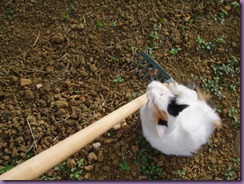
The next major job to get done before winter is to seed the orchard area.  This is about 1200 m2 and before seeding, it needed to be raked to remove the troughs caused by the cultivator digging in and by the tractor wheels.  I was slightly hampered too…Jewel decided I wasn’t taking enough attention of her and when she realised that I was ignoring her climbing posts and chewing them she took a far more direct approach and attacked the rake.

PA030005 tiny

The soil was in perfect condition for raking but it still took a whole day to rake the area.  I was trying very hard to get it done before the rain we had been promised arrive. This was taken about half way through.

PA030007 tiny 

Although the day stayed dry the wind was far too strong to allow me to seed which was probably jut as well since the rain we got was rather hard and might have washed all the seed to the bottom of the slope.  I now need to wait a couple more days until I can walk on the soil again and can then seed the area.

Since I couldn’t get on with the seeding that evening I took a stroll across my harvested field to pick a few more hazel nuts and rose hips.  On walking back my eye was caught by something in the harvesting debris.  My apologies for the lack of focus.

PA030008 tiny

Another sign that winter is approaching, a roe deer antler.  I think it is from a 3 year old, and it is 14 cm long.  I’ve always wanted to find antlers and have over the years spent time looking in woods but never finding any and then I find one when not looking, but that’s life isn’t it!

And a final sign for this post:

PA050001 tiny

Making use of a good drying day to wash the summer clothes before putting them away and bringing out the winter ones.

Sunday, 3 October 2010

Counting Down to Winter – part 1

It’s been nearly a week since my last summer visitor, my son ‘A’ left but is seems so much longer. ‘A’ had been here for nearly 7 weeks and between us we got a couple of the more difficult/time-consuming jobs done.  The first one was the hay-loft floor. This is a long running saga and starts about 2 and a half years ago; that’s when my other son ‘G’ fell through the hayloft floor while helping me stack bales. We decided that on his return visit we would re-floor the loft.

He returned last summer for a long stay, by which time I had also had a go at falling through the floor but thankfully didn’t succeed anywhere near as well as ‘G’.  After a few days of searching we found a reasonably local building suppliers and collected twelve 4m long flooring planks.  They only had the 12 so the other 88 I needed had to be ordered.  Not too much of a problem or so I thought; I’d glanced at the order and saw that the date was only a couple of weeks away.  Silly me, I didn’t think to check the month as well, I just assumed that a national chain of building supplies wouldn’t need nearly 2 months to obtain 88 flooring planks!  So ‘G’ and I put up the dozen planks we had obtained and the remaining planks arrived 2 weeks after he had left.

I put another dozen or so in on my own, a long task due to having to keep going up and down the ladder between measuring, cutting and fixing the planks and put in about the same again with the help of other friends over the course of late spring and early summer.  With ‘A’s’ help we put in all the remaining boards that we could, (I still have 3 support beams to replace before I can re-floor), and also removed an old pigeon loft which was in the corner of the hay loft.  We were then able to move all remaining planks onto the hayloft floor so they don’t have to spend another year outside.

As well as the hayloft, ‘A’ and I had another project, the polytunnel.  The instructions said it was a 2 day job for 2 people……. I beg to differ.

It took us around 3 weeks – not every day and not all day but long enough each day.  Making sense of the instructions was the first challenge.  It wasn’t that the instructions were lacking it was just making sure we got them right.  It would have been a lot faster if we’d put up a polytunnel before and knew what we were doing, so I was paranoid about making a mistake and ruining it.  Added to that the days were very hot and it is difficult reading instructions with sweat running into your eyes.  ‘A’ was very patient with me.

The site I chosen look relatively level and I’d rotavated the ground and raked it too, however once we’d put the support post in; a small matter of digging fourteen 30cm square and 50cm deep holes for the anchor plates, it became very obvious that the ground sloped quite steeply.

P9040075 tiny

The picture above shows the basic frame and the top of the boarding to the right is on a level with ground level on the left.  A lot of earth shifting was and still is required.  Thankfully the rotavator did and excellent job of digging into the rock hard ground and generating earth to backfill but I think that I will still be shifting earth throughout this winter before it is fully levelled inside and out. However:-

PA020003 tiny

The first planting is in :-)

Wednesday, 29 September 2010

Gathering and Gleaning


P9290009 tiny


It’s that time of year again, when everything seems to need to be done at once – oh wait, it always seems to be like that!  But it is also a good time of year, seeing what there is to harvest.

Today had been booked to pick up some sheep for some friends of mine and entailed a trip to near Limoges, a trip of 2 and a half hours each way.  And as often happens, at the last moment, (in my case 7pm the night before), something happened.  I was just hitching up the trailer and readying it for an early start the next day when a car pulled up.  The wife of the farmer who’s been helping me with my soya explained that her husband had just finished harvesting a field nearby and wanted to do mine.

So the said combine turned up a short time later and harvested until 10pm when the machine was full.  I’d arranged with the farmer that he would finish in the morning while I was away, so tomorrow I need to track down where the soya went and how much was harvested.

Having got back from the sheep pick-up I took a wander out onto the field and took a look at the hedgerow at the far side and within a few minutes I collected the above.

To the left is a wild form of sorghum which the chickens like.  At the top are few hazelnuts; this year the nut harvest is not one of the best due to the summer drought.  In the middle are some of the soya beans that I gleaned.  I’ll collect some more over the next few days but I’m also going to let the chickens out onto the field too so they can take advantage of what has been left.  At the bottom are some rosehips to the right, and sloes to the left.  Not many of either but by the time I’d got to them I’d filled the pot I had and couldn’t carry any more.  But….

here are some I picked earlier.

P9250004 tiny 

The sloes are nearly over, and many of the sloes on the bushes are shrivelled, again due to the drought, but I do have enough for one bottle of sloe gin.

The rosehips are destined for rosehip syrup; I don’t have enough yet for the syrup so will spend the next week or so collecting the necessary amount.

It’s also harvest time in the garden.

P9280005 tiny As you can see the butternut squashes are tiny but I’m really pleased with the giant pumpkin I’ve grown for Halloween.

P9280007 tiny

And finally for this post, my first almonds, all of them.  At the back are some quinces I had to take off a branch as there were far to many and the branch was in danger of breaking.  They are beginning to ripen and turn yellow, then it ill be quince jelly time, one of my favourites.